 EN
EN

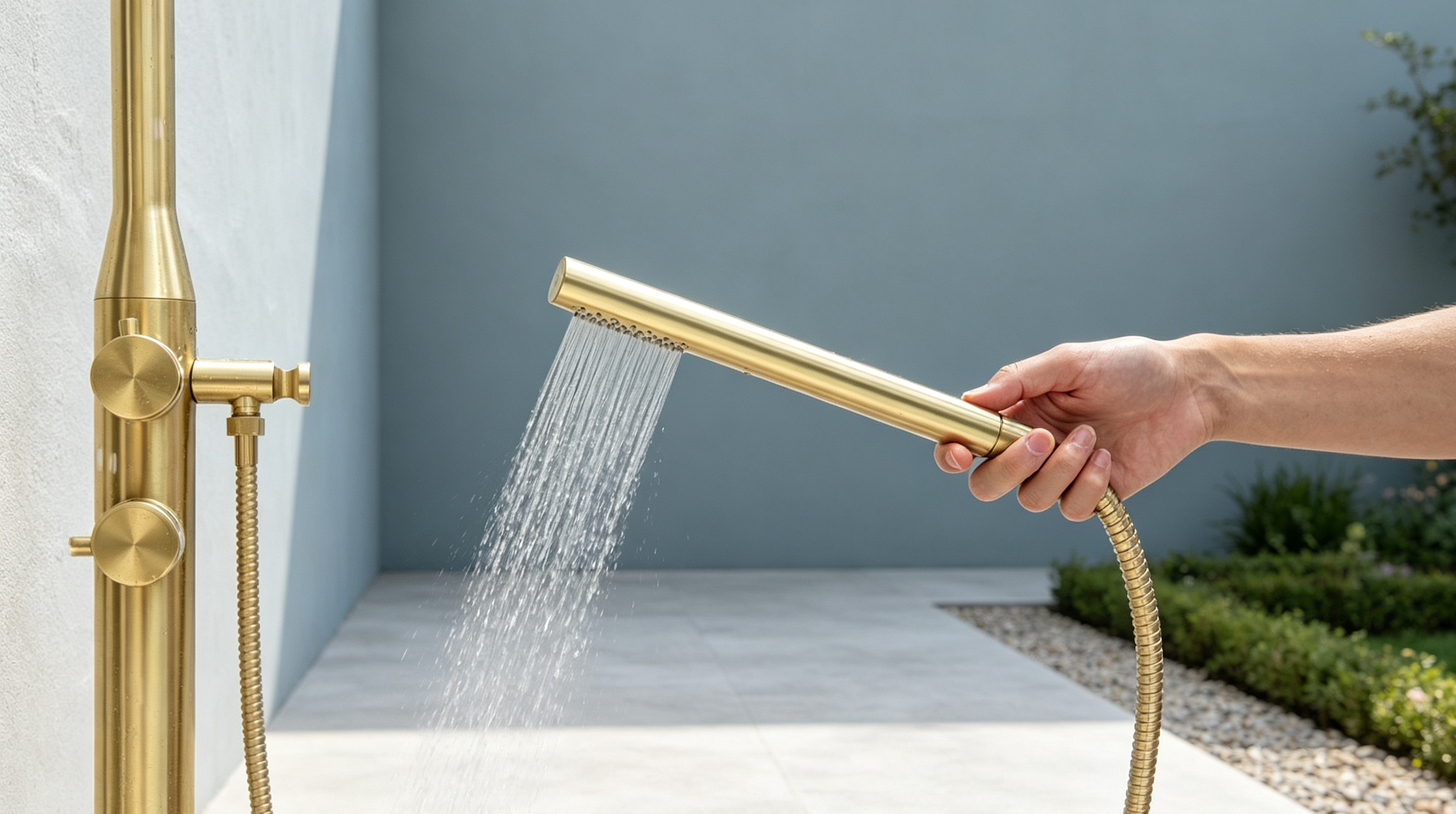
An outdoor shower can make a pool area, backyard, garden, or patio more convenient. It provides a practical place to rinse off after swimming, gardening, exercising, or working outdoors before going inside.
When choosing an outdoor shower kit, one of the most important decisions is whether to install a wall-mounted or freestanding model. Both configurations provide the same basic function, but their installation methods, space requirements, plumbing arrangements, drainage, maintenance, and placement flexibility can be very different.
A wall-mounted shower is secured to an existing structure, while a freestanding shower is supported independently by its own frame, column, or base. The better option is not determined simply by the product itself. The property layout, available support structure, water connection, drainage arrangement, climate, and intended permanence of the installation all need to be considered together.
This guide compares wall-mounted and freestanding outdoor shower kits so buyers can determine which configuration is better suited to a particular pool, garden, patio, or backyard project.
Outdoor Shower Kit: Wall Mounted vs Freestanding
The fundamental difference between the two configurations is how the shower is supported.
A wall-mounted outdoor shower kit uses an existing wall or structure. This can be a masonry wall, pool-house wall, reinforced fence, or properly framed exterior wall. The fixture remains close to the supporting structure and generally occupies less floor space.
A freestanding outdoor shower uses its own frame, column, legs, or base. It does not rely on an existing wall and can therefore be installed in more open areas, such as beside a swimming pool, in a garden, or in a dedicated outdoor shower zone.
This distinction affects almost every other aspect of the installation. Wall-mounted models are generally more compact and easier to integrate into existing architecture, while freestanding models provide greater freedom when selecting the shower location.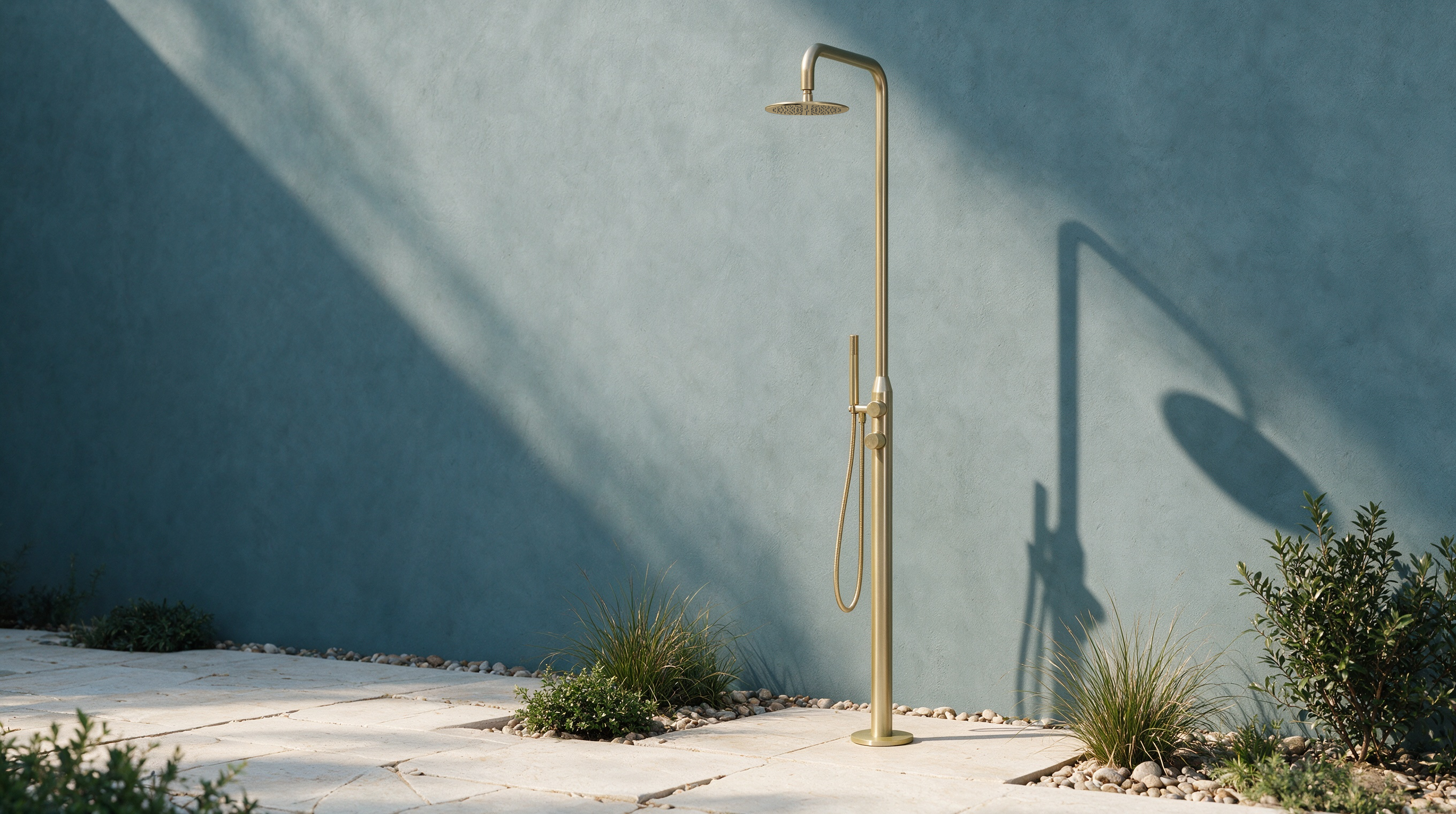
Wall-Mounted Outdoor Shower: Installation Requirements
A wall-mounted shower requires a structurally suitable surface capable of supporting the fixture and its mounting hardware. The quality of that support is particularly important because the shower will be repeatedly exposed to water and normal operating forces.
Mounting hardware should be secured to structural members rather than simply attached to siding, cladding, or decorative surface materials. A wood-framed installation may require fastening to studs, posts, or solid blocking, while masonry installations require anchors appropriate for the substrate.
The condition of the wall should also be assessed before installation. A lightweight fence panel or decorative wall may require reinforcement before it can safely support an outdoor shower.
Plumbing integration is another consideration. A wall-mounted model may be connected through the wall, inside the structure, or through an accessible surface-mounted supply line. When a pipe passes through an exterior wall, the penetration should be properly sealed to reduce the risk of water entering the wall assembly.
This is one reason wall-mounted models can work particularly well when the shower is located close to an existing building or pool house with accessible plumbing.
Freestanding Outdoor Shower: Installation Requirements
A freestanding shower does not require an existing wall, but it does require a stable independent support.
Depending on the product, the installation may involve a concrete pad, prepared paving, adjustable feet, structural base, or ground anchors. The base should provide sufficient stability for the height and weight of the shower and the forces generated during normal use.
The absence of a wall provides greater freedom when deciding where to place the shower. A freestanding model can be positioned next to a pool, near a garden, beside a recreational area, or in another location where there is no suitable building structure.
However, that flexibility does not mean installation is automatically simpler. When the shower is located away from an existing water connection, the supply line may need to be routed underground. Trenching, pipe installation, connection work, and protection of the supply line can add to the site preparation requirements.
A freestanding shower should therefore be regarded as a flexible installation rather than automatically as a portable one. A permanently anchored model may still require plumbing disconnection and base preparation before it can be relocated.
Space Requirements: Which Configuration Uses Less Space?
Wall-mounted outdoor showers generally have a smaller footprint because the supporting structure is vertical and already exists.
This makes them particularly useful for narrow side yards, compact patios, pool houses, and other locations where usable floor space is limited. The shower can also visually integrate with the surrounding building rather than appearing as a separate landscape structure.
A freestanding shower requires dedicated floor or ground space for its base and structure. Additional clearance may be necessary where the design includes a privacy screen, bench, or other accessories.
The trade-off is that a freestanding installation can become part of the landscape design. In a large garden or spacious pool area, the additional footprint may be acceptable and may even help define a dedicated outdoor shower zone.
Plumbing and Water Supply
Both wall-mounted and freestanding outdoor showers require an appropriate water supply. The main difference is how that supply reaches the fixture.
A wall-mounted model can often take advantage of nearby plumbing, particularly when installed against a building or pool house. The supply line may be concealed within the wall or connected through an accessible plumbing point.
A freestanding model may be more convenient when the shower needs to be located independently, but a longer supply route can be necessary. In-ground plumbing may require trenching and additional protection, particularly where the pipe is exposed to traffic, landscaping work, or freezing conditions.
The water connection should therefore be considered at the planning stage rather than after the mounting configuration has already been selected.
Drainage and Water Management
Drainage is an important part of any outdoor shower installation because regular discharge can leave water around the shower area.
For a wall-mounted shower, drainage should prevent persistent moisture from accumulating against the supporting wall or building foundation. Proper grading, permeable surfaces, drainage layers, or another suitable method can help direct water away from the structure.
For a freestanding shower, drainage should prevent water from pooling around the base, anchors, or surrounding ground. Gravel beds, permeable paving, or appropriately graded surfaces may be suitable depending on the installation.
The drainage solution should also consider how much water the shower will discharge and whether local requirements apply to outdoor wastewater management.
Pool Shower Applications
A pool shower is often installed near a swimming pool so users can rinse off chlorine, salt, sunscreen, grass, or dirt before entering a house.
A wall-mounted configuration can be convenient when the pool is immediately adjacent to a home, pool house, or other suitable wall. Plumbing can potentially be integrated with the nearby structure, while the compact design keeps the shower close to the building.
A freestanding pool shower can be more appropriate when the pool is located in an open part of the property or when users need to access the shower without approaching the house. It can also be positioned as part of a dedicated poolside area with landscaping or privacy features.
The shower location should allow convenient access without creating unnecessary pedestrian traffic through the house. Drainage, privacy, maintenance access, and the route to the water supply should all be considered before the final location is selected.
Outdoor Shower Fixtures and Material Selection
The choice between wall-mounted and freestanding designs should be accompanied by an evaluation of the outdoor shower fixtures themselves.
An outdoor shower may be exposed to sunlight, rain, humidity, temperature fluctuations, pool chemicals, and, in coastal areas, salt-laden air. Exposed components therefore need appropriate material and surface specifications.
Stainless steel, brass, aluminum, and other treated metals can be used in exterior plumbing products. The performance of each depends on the alloy, component construction, surface treatment, manufacturing quality, and exposure conditions.
For demanding outdoor applications, buyers should verify the actual material and grade rather than relying only on descriptions such as “weather resistant” or “marine grade.” For example, 316 stainless steel may be selected where increased chloride resistance is required, but the complete product specification still needs to be reviewed.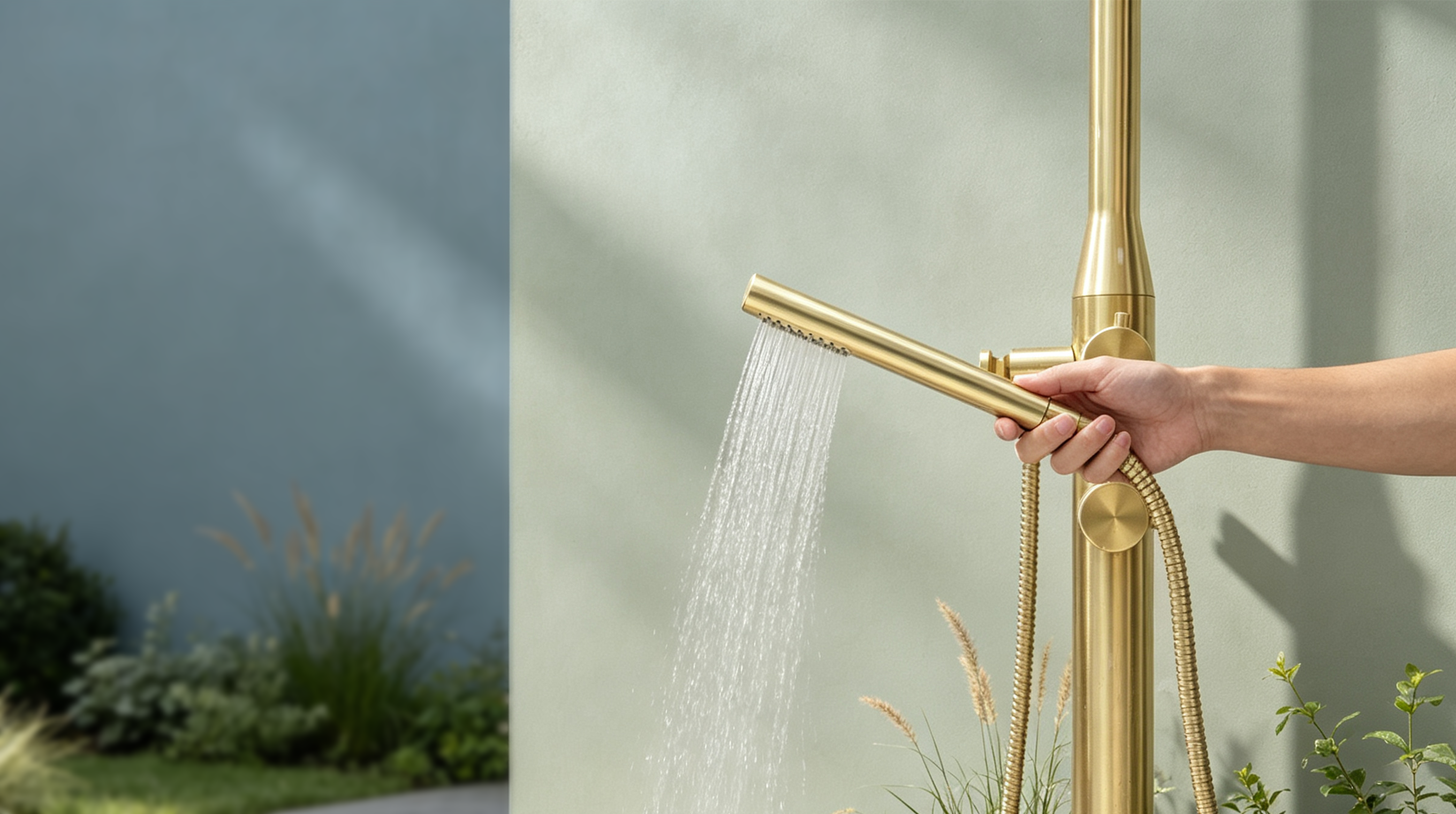
PVD Finish and Outdoor Surface Durability
A PVD finish is created through physical vapor deposition, in which a coating is deposited onto a substrate under controlled vacuum conditions.
PVD coating systems can be used for both decorative and functional purposes. Depending on the substrate, coating composition, surface preparation, and manufacturing process, a PVD finish can provide useful resistance to wear and environmental exposure.
However, PVD is a process category rather than a guarantee of identical performance for every product. Different coating systems can have different durability characteristics.
For poolside or coastal installations, buyers should therefore request available corrosion-resistance or surface-performance information from the manufacturer. Documented test data is more useful than assuming that all PVD finishes will perform equally outdoors.
The finish should also be maintained according to the manufacturer's cleaning recommendations, particularly where the shower is frequently exposed to pool chemicals or mineral deposits.
Faucet Lifespan and Long-Term Performance
The faucet lifespan of an outdoor shower is influenced by more than its external appearance.
The valve body, cartridge, seals, connections, hoses, surface finish, installation quality, and maintenance practices all contribute to long-term reliability. A durable exterior finish cannot compensate for poorly specified internal components, just as a high-quality valve cannot fully overcome unsuitable installation conditions.
Outdoor exposure can also create significant differences between locations. A sheltered backyard installation may experience much less environmental stress than a shower located beside a saltwater pool or in a coastal area.
Instead of relying on an unsupported lifespan figure, buyers should compare material specifications, component quality, warranty terms, maintenance requirements, and available performance documentation.
In freezing climates, winterization becomes particularly important. Water left inside exposed pipes or valves can freeze and expand, potentially causing damage. Seasonal shutdown and drainage should follow the manufacturer's instructions and applicable local requirements.
Outdoor Shower Plumbing Fixtures
The outdoor shower plumbing fixtures typically include the shower valve, showerhead, riser pipe, supply connection, shut-off valve, and related fittings.
These components need to be compatible with the water supply and the installation environment. Poolside installations may also require consideration of backflow protection depending on the connection arrangement and local plumbing requirements.
The actual plumbing design differs between wall-mounted and freestanding configurations. A wall-mounted model may be able to connect through an existing wall or nearby plumbing point, while a freestanding model may require a longer pipe route or underground supply line.
Where the outdoor shower is connected to potable water, the plumbing arrangement should be reviewed against the applicable local requirements before installation.
Maintenance: Wall Mounted vs Freestanding
The two configurations have different maintenance points.
Wall-mounted showers require periodic inspection of the mounting hardware, wall penetrations, sealants, plumbing connections, and areas where water may contact the supporting structure.
Freestanding showers require attention to their independent base, anchors, lower connections, exposed fasteners, and drainage around the installation.
Both should be checked periodically for loose connections, worn seals, corrosion, finish damage, leaks, and mineral buildup. Keeping the shower clean according to the manufacturer's instructions can also help preserve the surface and internal components.
The difference is therefore not that one configuration is maintenance-free. Rather, wall-mounted models require more attention to the interface with the supporting structure, while freestanding models require greater attention to the independent base and ground-level components.
Installation Cost: Wall Mounted vs Freestanding
The mounting style alone does not determine installation cost.
A wall-mounted shower can appear simpler when a suitable structural wall and nearby water connection already exist. However, structural reinforcement, drilling, waterproofing, wall modifications, and concealed plumbing may add installation work.
A freestanding shower may avoid structural modifications to a building, but it can require a dedicated foundation or base, anchoring, underground plumbing, and additional site preparation.
For this reason, the location of the existing water supply and the amount of structural or ground preparation required can influence total installation cost more than the product's mounting style.
Certification Standards and Product Requirements
Certification standards vary according to the destination market, product category, water supply, and installation conditions.
Buyers should identify the requirements that apply to the exact outdoor shower product rather than assuming that one certification automatically covers every configuration.
Depending on the market and application, relevant requirements may address plumbing supply fittings, water efficiency, backflow protection, material safety, or other performance characteristics. Products connected to potable water may be subject to additional requirements concerning materials and contaminant release.
For B2B projects, manufacturers should be able to provide the applicable certification information, test reports, material documentation, installation instructions, and product specifications.
Compliance should be confirmed before production or installation, especially for projects involving multiple markets or large purchase quantities.
Wall Mounted vs Freestanding: Which Is Better?
A wall-mounted outdoor shower is generally attractive when an appropriate structural wall already exists, the installation area is relatively compact, and integration with an existing building or pool house is desirable. Its smaller footprint can make it particularly practical for narrow or space-constrained locations.
A freestanding outdoor shower is generally more suitable when there is no appropriate wall or when the shower needs to be positioned independently within an open landscape. It provides greater flexibility for poolside placement and can accommodate privacy screens, benches, and other landscape elements without modifying an existing building.
The more important distinction is therefore not which configuration is inherently better, but which installation approach creates the most practical overall system for the property.
Outdoor Shower Kit: Final Comparison
When comparing an outdoor shower kit, consider the entire installation rather than the shower structure alone.
A wall-mounted model can provide a compact solution that integrates with an existing building. It can be particularly efficient when the water connection is already close to the intended location.
A freestanding model can provide greater placement flexibility and is well suited to open pool areas, gardens, and dedicated outdoor shower spaces. The additional installation work associated with the independent base and plumbing should nevertheless be included in the project assessment.
Material and component specifications matter in both configurations. Buyers should review the fixture body, valve, cartridge, connections, finish, mounting hardware, and available performance information.
For pool shower applications, drainage and water-supply planning should receive particular attention. For installations in coastal areas or near saltwater pools, the material and finish specification may become more important. For cold climates, proper winterization should be planned before installation.
Conclusion
The choice between a wall-mounted and freestanding outdoor shower kit should be made as an installation decision rather than simply a style preference.
Wall-mounted showers are particularly practical where a structurally suitable wall already exists and available floor space is limited. Their compact footprint and architectural integration can make them a good fit for pool houses, patios, narrow yards, and building-adjacent installations.
Freestanding showers provide greater freedom when the preferred location is away from a building or when the shower is intended to become an independent feature of a pool or garden. They require their own structural support and may involve additional base preparation and water-supply work.
The fixture specification matters in both cases. Outdoor shower fixtures should be evaluated for material, finish, valves, connections, plumbing compatibility, maintenance requirements, and relevant certification standards. For high-exposure locations, surface treatment and material selection should be supported by documented product information rather than general marketing claims.
Whether you are installing a residential pool shower, upgrading a backyard, developing a hospitality project, or sourcing outdoor shower products for distribution, comparing the installation method, product specification, and long-term service requirements together can lead to a more reliable purchasing decision.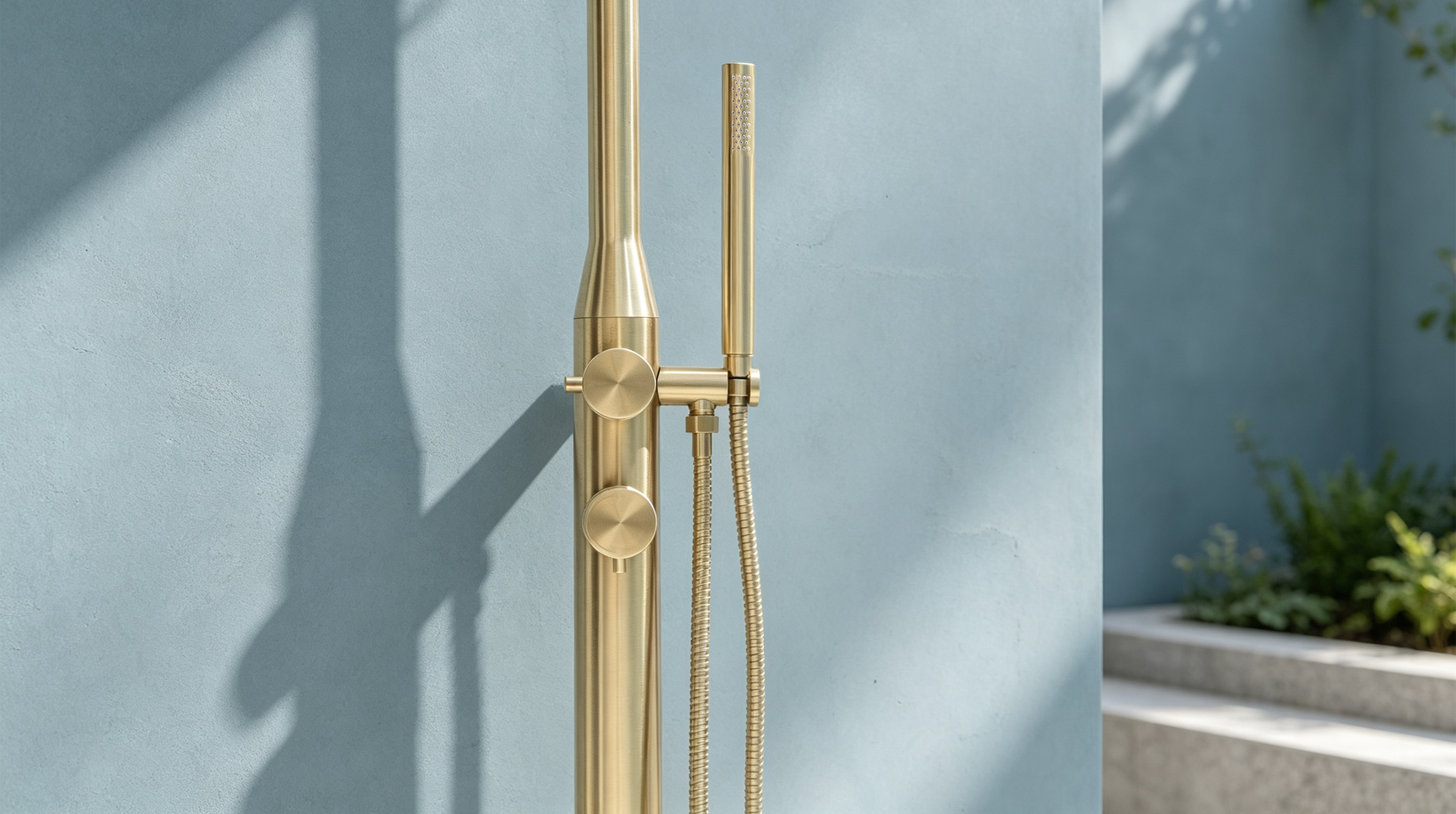
Explore Our Outdoor Shower Collection
Our outdoor shower solutions include wall-mounted and freestanding options for poolside, backyard, patio, and garden applications.
Explore different materials, finishes, mounting configurations, plumbing options, and accessory combinations to find an outdoor shower kit suited to your project.
Contact us to discuss outdoor shower fixtures, PVD finish options, outdoor shower plumbing fixtures, faucet lifespan, certification standards, OEM/ODM requirements, and bulk purchasing solutions.
Table of Contents
- Outdoor Shower Kit: Wall Mounted vs Freestanding
- Wall-Mounted Outdoor Shower: Installation Requirements
- Freestanding Outdoor Shower: Installation Requirements
- Space Requirements: Which Configuration Uses Less Space?
- Plumbing and Water Supply
- Drainage and Water Management
- Pool Shower Applications
- Outdoor Shower Fixtures and Material Selection
- PVD Finish and Outdoor Surface Durability
- Faucet Lifespan and Long-Term Performance
- Outdoor Shower Plumbing Fixtures
- Maintenance: Wall Mounted vs Freestanding
- Installation Cost: Wall Mounted vs Freestanding
- Certification Standards and Product Requirements
- Wall Mounted vs Freestanding: Which Is Better?
- Outdoor Shower Kit: Final Comparison
- Conclusion
- Explore Our Outdoor Shower Collection